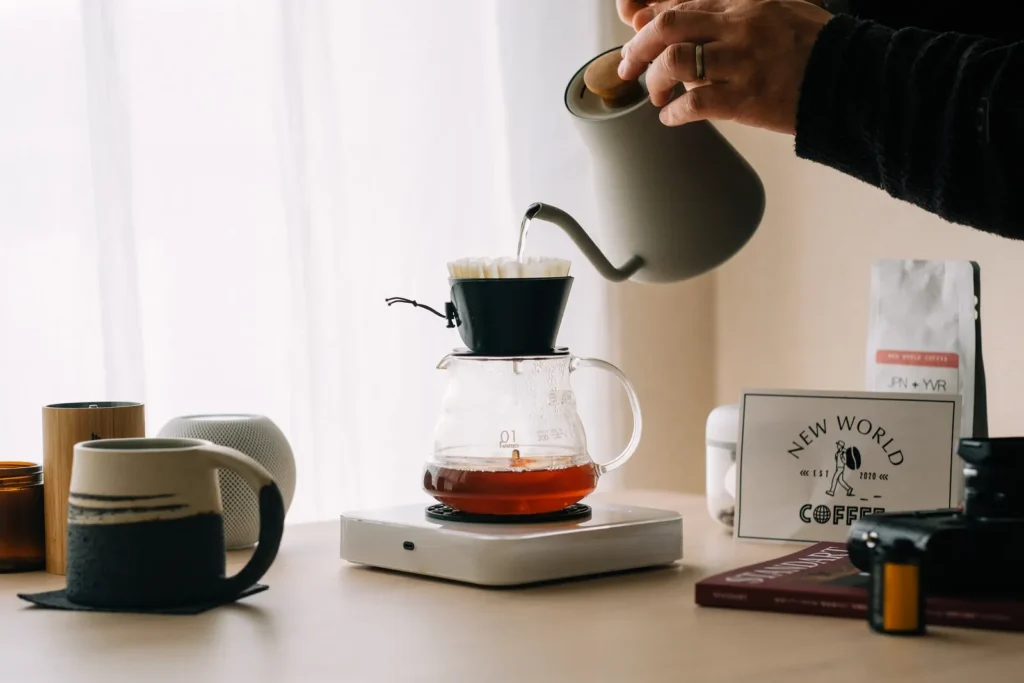
Begin with the ordinary morning
A good coffee corner is a short, repeatable route from cupboard to cup. It does not need a dedicated trolley or an espresso machine to earn the name. Think about the morning you have most often: how much time is available, how many people want a drink and whether you enjoy paying attention to the brewing or would prefer to press a button.
The useful starting point is the coffee you like to drink. A long mug taken to the kitchen table asks something different from a small espresso or several milk drinks made in quick succession. Choose a method that suits that preference and your willingness to maintain it. Equipment that is impressive on a quiet Sunday can be a poor fit for the rest of the week.
Measure the movement as well as the footprint
Clear the intended patch of worktop and rehearse the sequence with the equipment you already own. Where will the water come from? Where will the used grounds go? Can you open a reservoir or cupboard without moving everything? A machine’s listed width and depth do not describe the space needed to use it.
Keep the hot, wet stages away from the edge and follow the appliance maker’s requirements for clearance and electrical use. A tray may make small objects easier to group, but it should not trap water around electrical equipment. Give a damp brewer somewhere suitable to dry rather than returning it immediately to a closed cupboard.
Choose a level of involvement you enjoy
A manual brewer can suit someone who enjoys controlling the process and does not mind a few deliberate steps. An automated method can be more attractive when convenience matters or several cups are needed. Espresso introduces a different set of choices around grinding, preparation, milk handling and cleaning; the machine is only one part of that routine.
These are differences in workflow, not a ranking of taste or seriousness. Start by making your current method more consistent. Use the same cup or measured quantity, note what changes and adjust one variable at a time. That makes it easier to discover whether the problem is the process or whether another piece of equipment would solve something specific.
Give the essentials a sensible home
Keep the coffee, filters if needed, scoop or scales and the cups you use within an easy route. Store each item according to its instructions, and buy quantities that make sense for your household rather than the container you want to display. A coffee corner should make the next cup easier without turning the entire worktop into storage.
Leave room for the less photogenic essentials: a cloth, somewhere for used grounds and access to the sink. Cleaning is part of brewing, so check the manufacturer’s directions for removable parts, cleaning products and descaling. Do not assume a part is dishwasher-safe or that the same routine applies to every machine.
Upgrade the inconvenience you can name
Before spending more, finish this sentence: the change I need is… Perhaps the current brewer makes too little for two people, the grinder is awkward to clean or the machine cannot fit beneath the cupboard. A specific inconvenience creates a useful shopping brief; a photograph of somebody else’s kitchen rarely does.
For a small space, fewer objects with a defined purpose may be more valuable than a complete matching set. For a household with different morning schedules, easy cleaning and straightforward access may matter most. Add an item when it improves the drink or removes a repeated frustration. The result can still look considered, but its real success is how naturally it fits into the morning.
More considered stories,
from the Liberad journal.