Start with the day you can comfortably repeat
The best base for a first Swiss Alps trip is not necessarily the one nearest the most famous summit. It is the place from which you can have a satisfying day when the higher mountain outing does not happen. Picture breakfast, a manageable walk, somewhere to stop and a straightforward return. Then choose the bigger excursion that fits around that foundation.
A short stay benefits from concentrating on one valley or a compact region. Moving accommodation repeatedly consumes time and makes luggage part of every plan. Before booking, compare the station or bus stop with the actual lodging entrance. A mountain view on a booking page does not explain the gradient of the final walk or the arrangements for arriving after dark.
Understand the route category
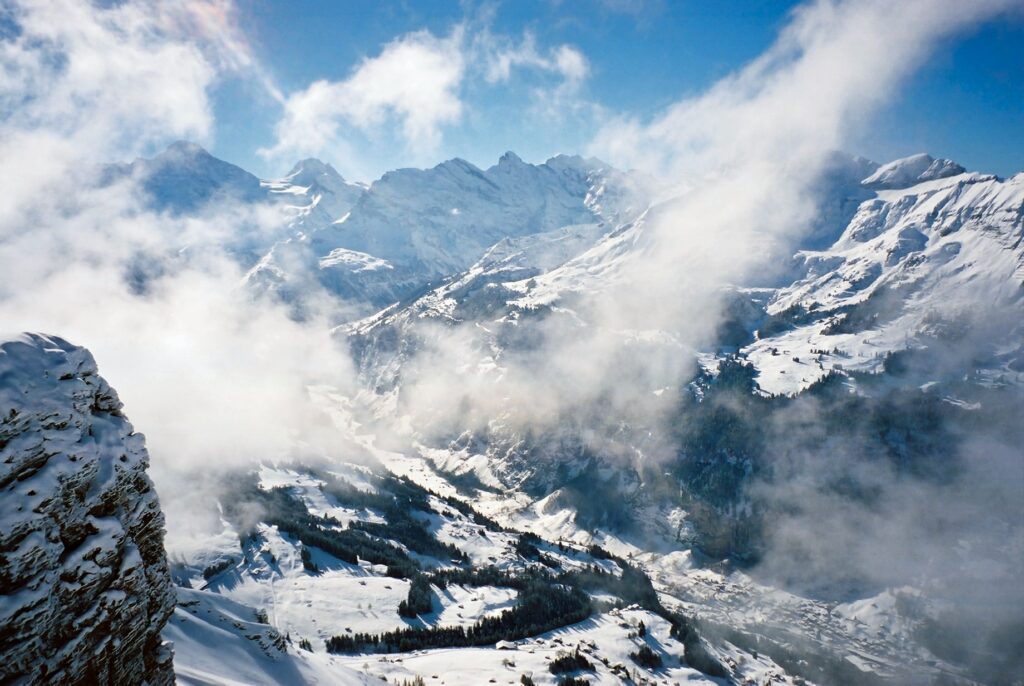
Swiss walking information distinguishes ordinary hiking, mountain hiking and alpine routes. The signposting uses yellow for hiking routes, white-red-white for mountain routes and white-blue-white for alpine routes. These categories are a starting point for assessing the demands of a walk, not a promise that any marked route is suitable for your group.
Look at ascent, descent, exposure, surface, duration and escape options as well as distance. A short route with steep or exposed sections may be more demanding than a longer valley walk. If the published description exceeds your experience, choose another route or seek qualified local guidance. A gondola to a high starting point does not remove the demands of walking at that altitude.
Separate transport convenience from route suitability
Check the current operating calendar and the final return service for each railway, cableway or bus you plan to use. A line shown on a map does not tell you whether it runs on your dates. Allow a realistic margin rather than making the last departure the target. A group member who needs a slower pace should not have to race a timetable.
Transport passes deserve the same practical calculation as any other holiday purchase. List the journeys you expect to take, check which services and fare reductions apply, and compare that with individual tickets. Do not assume that every mountain service is fully included because a pass has a national name. Keep a copy of the relevant terms with the itinerary.
Use a two-plan approach to the weather
For each day, write down a higher outing and a lower, less demanding alternative. Make the final choice using the current local forecast, route condition reports and operator information. It is more useful to have a good valley day ready than to argue with a forecast because a summit photograph was the main reason for booking.
Pack and prepare for the walk you select, including suitable footwear, layers, water and navigation. Tell someone your plan where appropriate, keep phone power available and understand how to obtain help. General packing advice cannot replace route-specific preparation; ask locally if conditions, closures or your group’s abilities create uncertainty.
Choose accommodation for recovery too
A balcony can be lovely, but storage for wet kit, convenient evening food and a comfortable place to rest may matter more after a walking day. Ask about breakfast times if you intend an early departure. If travelling with children or a mixed-ability group, make sure a gentler day is possible without complicated transfers.
Read current FCDO Switzerland travel advice before departure, and check that insurance covers your planned activities and any relevant altitude limits. The strongest first Alps itinerary is usually modest on paper: one workable base, a few carefully chosen outings and permission to change the order. You can return for another valley; there is no need to make the first holiday cover the entire mountain range.
Source notes: Verbier–Val de Bagnes tourist office trail information; Swiss Federal Office of Topography hiking-map guidance; FCDO Switzerland travel advice. Checked 22 October 2026.
More considered stories,
from the Liberad journal.