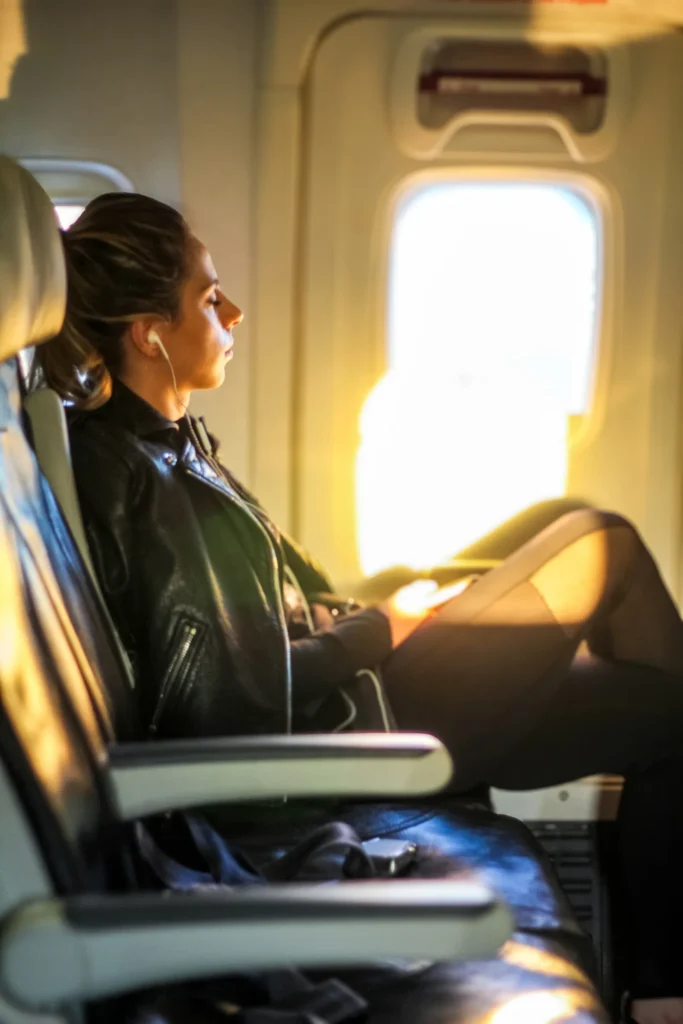
The right travel headphones must work after the novelty has worn off and the cabin lights have dimmed. They have to coexist with glasses, a headrest, a film soundtrack and the small bag at your feet. Begin with the flight you take most often, not a list of the most expensive models.
Give comfort more than a quick try-on
Wear a prospective pair long enough to notice clamping pressure, ear contact and the effect of your glasses. Check whether the cushions fully surround your ears or press on them. A soft finish can feel inviting for a minute and become less comfortable over time. Move your head as you would against a seat and see whether the ear cups catch or shift.
If you prefer earbuds, think about fit, handling and how easily you can remove one when cabin crew speak to you. A small case is convenient only if you can find it without dropping it in the seat. Neither earbuds nor over-ear headphones are automatically the better travel choice; sleeping position and your own fit often decide more than a specification table.
Understand the job of noise cancellation
Sony’s technical explanation describes active noise cancellation as more effective against steady low- and mid-pitched sound than rapidly changing sound. That helps set expectations for a cabin: cancellation can reduce some background noise without producing complete silence or making voices disappear. The physical fit still matters.
Try the controls for cancellation, transparency or ambient mode. You should be able to change them without studying an app every time. Do not assume a setting that feels impressive in a shop will be comfortable for you throughout a long flight. A return policy that genuinely allows an appropriate trial can be more useful than an unsupported claim of the strongest cancellation.
Check the unglamorous connections
If you use the aircraft’s entertainment screen, confirm whether the headphones can receive audio through a cable, which connector is required and whether powered features continue to work in that mode. Some systems need an adapter, but the aircraft and airline determine the details. A wireless specification does not establish compatibility with every seat.
Read battery figures together with the conditions under which they were measured. Noise cancellation, calls, volume and connection mode can change use time. Check the charging port, whether playback is possible while charging and what happens when the battery is empty. Pack the needed cable where it can be reached, rather than in a bag that might be placed in the hold.
Make listening level part of the choice
The World Health Organization emphasises both sound level and listening duration and recommends well-fitting, noise-cancelling headphones to reduce the urge to raise volume in noisy places. Look for useful exposure monitoring or volume controls, and give your ears breaks. Cancellation does not make every chosen volume safe.
Keep enough awareness for instructions and announcements. Consider how quickly you can pause playback and remove or change modes. If you develop persistent ringing or hearing difficulty, seek appropriate professional advice rather than assuming an upgrade will solve it. Travel comfort is a wider question than finding the loudest or most immersive sound.
Pack the complete system once
Before departure, put the headphones, case, cable and any confirmed adapter into your usual cabin bag. Check that you can reach them without unpacking everything. For a frequent flyer, the winning pair is the one whose fit and connections stay easy through the actual journey. That may be a familiar, serviceable set rather than the model leading a general ranking.
More considered stories,
from the Liberad journal.