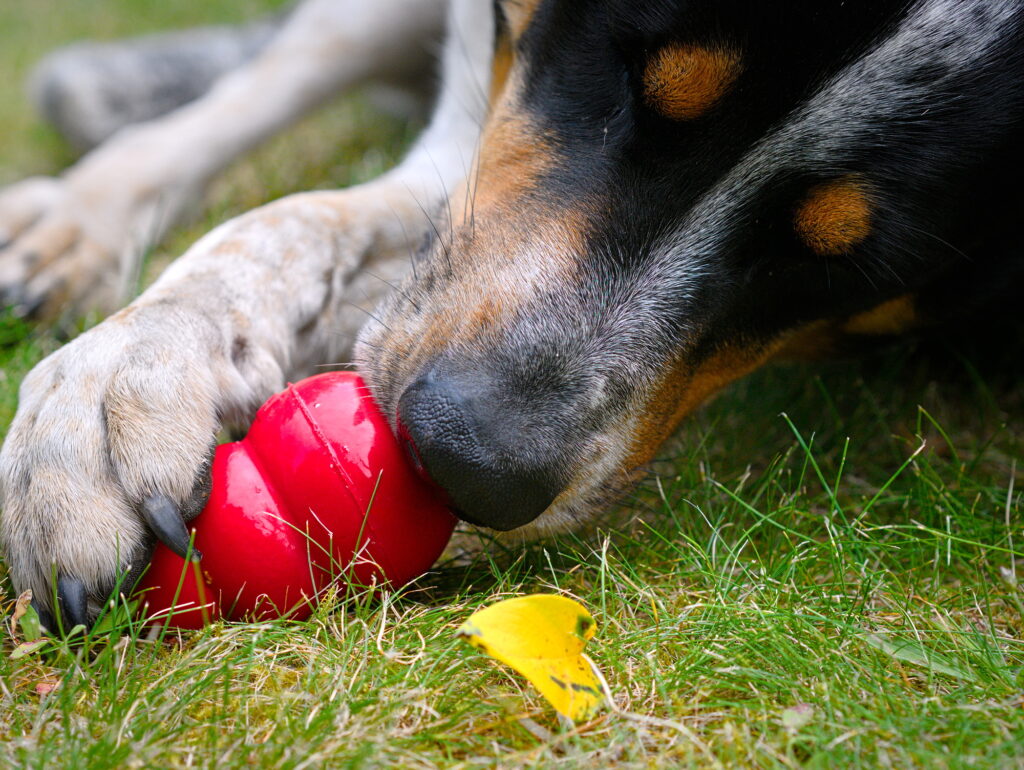
Watch what your dog does with a toy
Some dogs carry a favourite object from room to room. Others work quietly to remove food from a hollow toy. Some try to dismantle anything offered. Those are different uses, and they should lead to different buying questions. Before choosing a KONG, describe the activity you want to provide and how your dog usually interacts with toys.
A plush companion is not a substitute for a product intended for sustained chewing. Equally, the firmest rubber is not automatically the right choice for every dog. Age, mouth size, chewing behaviour and the particular product’s instructions all matter. Start with those details instead of searching for one universally toughest toy.
Explore KONG’s official website ↗
Understand the familiar rubber colours
KONG distinguishes its rubber ranges by intended life stage and chewing style. The Classic red range is described for average chewers; black Extreme uses a more durable formula; Puppy and Senior ranges use softer formulations. That is a selection framework from the manufacturer, not a guarantee that a particular dog cannot damage a toy.
The KONG name also appears on products with different materials and uses. Read the information on the exact item rather than extending the reputation of a rubber toy to a rope, plush or interactive product. If buying a replacement, check that the model and size match what you intended; a similar-looking photograph is not enough.
Size for the mouth as well as the weight
The official sizing guidance asks owners to consider head and mouth size alongside the weight guidance. Follow the chart for the product and ask for help if uncertain. Do not choose a smaller size simply because it costs less or looks easier to fill. In a home with multiple dogs, consider the possibility that a larger dog will gain access to the smaller dog’s toy.
Keep the packaging until you have checked the instructions, and introduce the toy while you can observe what happens. A dog may use an unfamiliar object differently from the way a product photograph suggests. The first session is an opportunity to assess suitability, not a reason to leave the dog alone with it.
Make a food activity achievable
If you choose a stuffable design, begin with a task the dog can understand. A difficult filling is not automatically better enrichment. Use food appropriate to the individual dog and account for it within their normal feeding plan. If dietary restrictions or medical needs apply, ask your vet what is suitable instead of borrowing a recipe designed for another animal.
Choose a place where you can supervise and clean up. In a multi-dog household, manage access so that food does not become a source of conflict. A toy can be part of an activity routine, but it is not a cure for severe anxiety or a substitute for professional advice when behaviour causes distress.
Inspection is part of using the product
KONG explicitly states that no dog toy is indestructible and recommends supervision and regular inspection. Remove a damaged item from use. If you suspect a piece has been swallowed, contact a vet rather than assuming that a branded material will pass without a problem. Those limits are important even when the toy initially seems robust.
Follow the cleaning instructions for the exact material and shape. A food-filled toy that is awkward to clean may not fit your routine, however appealing the idea sounded. A small number of suitable, inspected toys is easier to manage than a basket of uncertain items.
The useful KONG purchase is the one that fits a defined activity and an individual dog. Choose the appropriate range, check the size, supervise the introduction and keep inspecting it. That process provides a more reliable basis for choosing than an unsupported premium label or an indestructible claim.
Explore KONG’s official website ↗
Source notes: KONG choosing and sizing guidance, official FAQ and durability information. Checked 22 October 2026.
More considered stories,
from the Liberad journal.