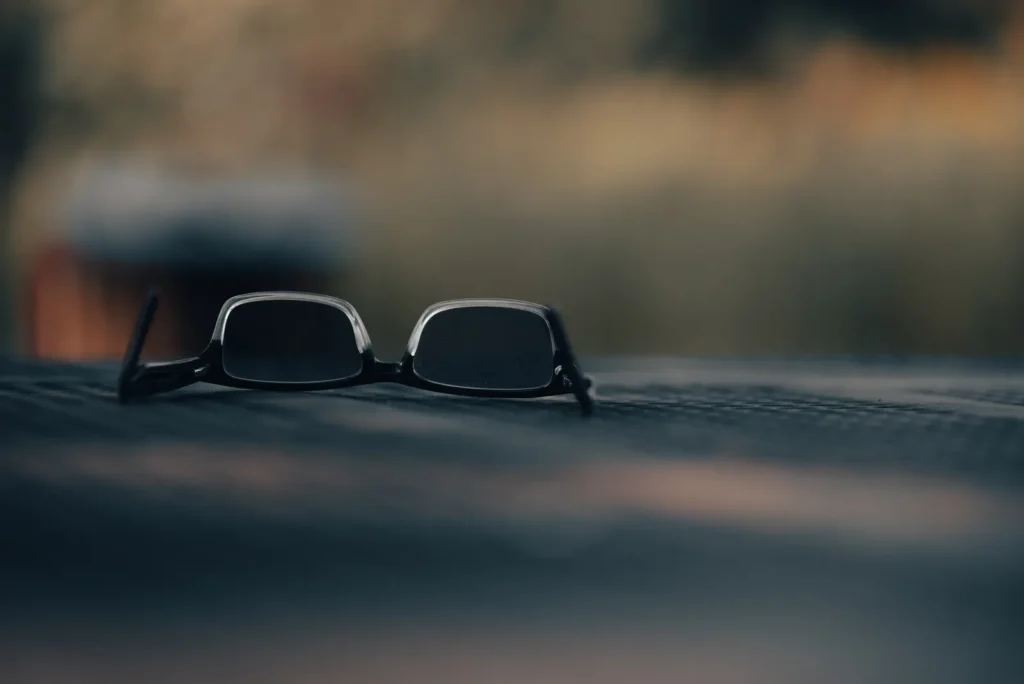
A frame can flatter in a mirror and still slide down your nose at the first warm afternoon. Another can look understated but leave a distracting gap of light at the side. Treat sunglasses as something you will look through and move in, then decide how strongly you want the frame to feature in your outfit.
Read the protection information first
The NHS advises choosing sunglasses that provide sun protection, with appropriate marking, and notes the usefulness of wraparound lenses or wide arms. Check the information supplied with the actual pair. Dark lenses, a designer name and a high price do not by themselves document the protection offered.
Keep UV protection separate from tint, polarisation and intended use. These describe different properties. If you need sunglasses for driving, ask an optometrist about the lens category and suitability for the conditions in which you drive; do not assume the darkest available tint is the most useful. A pair selected for a holiday photograph may not answer a motorway glare problem.
Use a moving fit check
Look straight ahead, then down as if reading a phone, and turn your head gently. The frame should stay comfortably in place without pinching. Check the bridge, pressure behind the ears and whether your eyelashes brush the lens. If you wear prescription glasses, compare options that genuinely meet that need rather than hoping an uncomfortable fit will improve with time.
Try the sunglasses with the hat or helmet you actually use. Wide arms may conflict with another item, while a narrow frame may admit more side light than you expect. Ask whether the nose pads and arms can be adjusted and whether replacement parts are available. An adjustment should refine a sensible fit, not rescue a frame whose basic dimensions are wrong.
Let proportion replace rigid face categories
Round, square and heart-shaped face charts can offer a starting point, but they are too blunt to decide a purchase. Instead, compare the frame width with your face, the top edge with your eyebrows, and the lower edge with your cheeks when you smile. A large frame may suit the look you want while still needing enough bridge support to stay put.
Take a photograph from a normal conversation distance, rather than relying entirely on a close selfie. Phone perspective can exaggerate a central feature and make a frame look different from how another person sees it. Study the whole silhouette with your hair as you normally wear it. Colour, thickness and finish can change the effect as much as the outline.
Make the lens choice fit the day
For walking around town, comfortable all-day wear and easy storage might lead the decision. For water, snow or a long bright route, seek advice appropriate to that setting and avoid treating ordinary fashion frames as specialised protection. The NHS highlights reflected light from surfaces including snow and water as a reason to take eye protection seriously.
If you are comparing prescription lenses, ask for the complete cost, fitting process and what happens if the result is uncomfortable. Confirm any remake or return terms before ordering a custom product. A frame-only price is not a useful comparison with a finished prescription pair. Keep the supplied protection information and care instructions after purchase.
The final five-minute comparison
Set aside the pair you most liked in the display and compare it with one quieter alternative. Wear each for a few minutes, check pressure points, look through the lenses at a straight edge and read the supplied information. If either fit or protection remains uncertain, pause and ask a qualified optometrist. The most flattering choice is a pair you can wear comfortably for its intended purpose, with the protection established rather than assumed.
More considered stories,
from the Liberad journal.