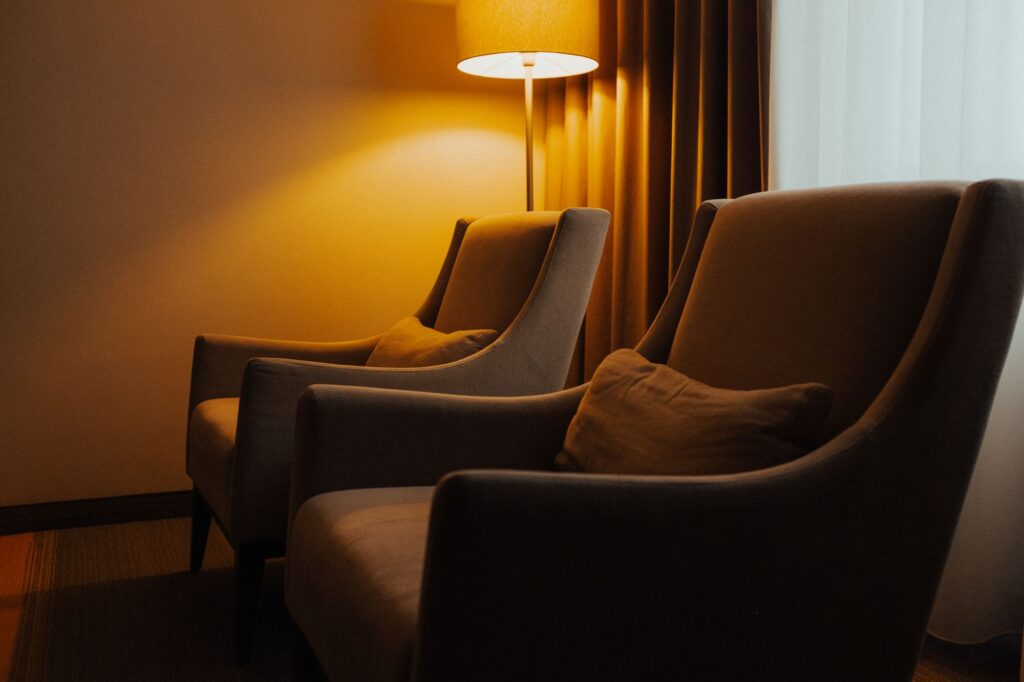
Start from the chair
A floor lamp can look beautifully proportioned beside an armchair and still shine straight into your eyes when you settle back. Before looking at finishes, sit where you normally read with the book you are most likely to pick up. Notice the height of the page, the chair arms and the space your hand can reach without stretching.
These are more useful starting points than a catalogue photograph. Mark out the available base area with a sheet of paper, leaving a clear route around the chair. Then consider where the light source would sit when you are upright and when you lean back. A lamp needs to work from both positions if both are part of the way you use that corner.
Choose where the light should fall
A broad fabric shade gives a softer pool of light and can help a room feel welcoming. It also spreads light beyond the book. An adjustable reading head offers more control over direction, which may be useful if someone else is watching a screen nearby. That smaller beam can feel less forgiving if you move around while reading.
Look at the inside of the shade and the position of the bulb, not just the silhouette. The aim is to illuminate the page without an exposed bright source in your line of sight. If the fitting is adjustable, check that the head can reach the page while the base remains stable and the arm stays clear of your face.
Read the bulb specification separately
Lumens describe a bulb’s brightness; watts describe its power use. Those figures answer different questions, so a low wattage alone will not tell you whether the page will be comfortably lit. Colour temperature describes the appearance of the light. A warm-looking bulb may suit the room, while the amount and direction of light still need to suit the reading task.
There is no single lumen figure that can settle every reading corner. Shade material, distance from the page and your own preferences affect the result. Treat a dimmer as a way to adjust an already suitable lamp, and confirm that the bulb and fitting are compatible with the dimming system. An unsuitable bulb can turn an appealing feature into a frustrating purchase.
Think about the small repeated actions
A foot switch tucked behind the chair may seem unimportant in daylight. It becomes the main event when you want to put the book down without getting up. Check switch position, cable length and the route to the socket. Touch controls need to be easy for you to find and operate; a physical switch may feel more predictable.
A replaceable bulb leaves you a separate choice of light source later. With an integrated LED, look for clear information about serviceability, warranty and what happens if the light source fails. Neither construction is automatically the right answer: the practical question is whether you understand the maintenance and replacement route before buying.
Make the final check in context
For a dedicated reading chair, prioritise the direction of the beam, reachable controls and enough adjustment for your usual positions. For a room that also needs ambient light, a broad shaded lamp may be the more useful compromise. For a narrow corner, measure the base and adjustment space rather than assuming a slim-looking design will fit.
Before ordering, check dimensions, bulb cap, maximum permitted lamp rating, dimmer compatibility, cable arrangement and the seller’s current returns terms. Follow the manufacturer’s safety instructions, leave safe circulation space and avoid covering the fitting or trapping the cable. The best-looking option earns its place when it lights the book well and makes the corner easier to use.
More considered stories,
from the Liberad journal.